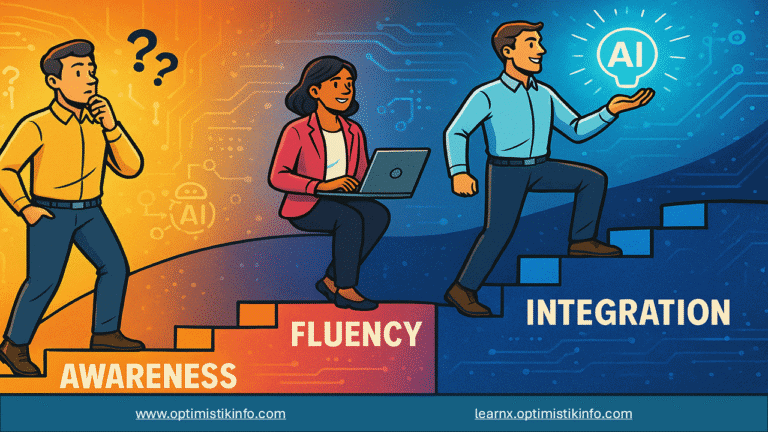


Let’s be real: AI is moving faster than our morning coffee kicks in. One day you’re asking ChatGPT for memes, the next day your company wants an internal AI chatbot that reads policies, books tickets, and talks like a human. The gap between “using AI” and “building AI” is where the real career magic sits — and that’s exactly why the AI Engineer role is blowing up.
Why the AI Engineer role is exploding right now
AI adoption is on beast mode. Every industry — IT, healthcare, BFSI, manufacturing, retail, logistics — is rewriting workflows with AI.
And companies don’t just want “AI enthusiasts” anymore. They want people who can:
- Build LLM-powered systems
- Automate tasks end-to-end
- Integrate AI with APIs, CRMs, ERPs, and internal tools
- Deploy models securely
- Reduce hallucinations
- Make AI outputs enterprise-safe
That combination is exactly why the AI Engineer role is one of the fastest-emerging roles globally.
If you understand the 10 concepts below, you’re instantly more capable than 80% of people who are “learning AI” through just prompt writing.
1. Context Engineering
The new heart of AI engineering.
What it means:
Giving the model the right context so it responds accurately.
Three major components:
- Few-shot prompting: Provide examples → model mimics pattern
- RAG: Provide relevant internal documents → model grounds answers
- MCP: Provide access to tools/APIs → model can act, not just chat
Example:
User asks: “What is my refund status?”
Your system:
- pulls order data (API),
- fetches refund policy (vector DB),
- adds examples of how to respond (few-shot),
- sends all that + query to LLM.
That is context engineering in practice.
Why it matters:
The entire performance of your AI system depends on this pipeline. Bad context = wrong answers.
2. Large Language Models (LLMs)
The engine behind every modern AI product.
What it means:
An LLM predicts the next token in a sequence. That’s the whole trick — but the emergent behavior looks like intelligence.
Example:
Input: “All that glitters…”
LLM predicts: “…is not gold.”
Why it matters:
As an AI engineer, you must know:
- capabilities
- limits
- hallucination patterns
- token costs
- performance differences between models
This knowledge decides which model you choose for your product.
3. Tokenization
How machines break text down.
What it means:
LLMs don’t understand words — they understand tokens (sub-words).
Examples:
- “running” → run + ning
- “glitters” → glitt + ers
- “unbelievable” → un + believ + able
Why it matters:
Tokenization impacts:
- cost (more tokens = more $$$)
- context length
- how well models understand suffixes/prefixes
- performance
Real-world scenario:
“How many emails did I send last week?” may tokenize differently depending on synonyms — which impacts cost and speed.
4. Vectors & Vector Databases
The foundation of AI search and RAG.
What it means:
A vector is a coordinate representing meaning.
A vector database stores them and enables semantic search.
Example:
Query vector for “angry customer” will sit close to vectors like:
- “frustrated user”
- “dissatisfied client”
So the system retrieves correct documents even without exact keywords.
Why it matters:
You can build:
- support bots
- knowledge assistants
- policy-aware copilots
- internal enterprise search
All using vector DBs.
5. Attention Mechanism
How the model knows which words matter.
What it means:
Attention lets the model look at nearby words to infer meaning.
Examples:
- “tasty apple” → fruit
- “Apple revenue report” → tech company
- “apple of my eye” → expression of affection
Why it matters:
This mechanism is why LLMs outperform older models like LSTMs or RNNs.
As an engineer, understanding attention helps you debug bad responses.
6. Transformers
The architecture behind LLMs.
What it means:
Transformers =
Tokenization → Attention → Neural Network Layers → Output Prediction
Example:
A 24-layer transformer may process “The crane ate the crab” and:
- Layer 1 → understands “crane” = bird, not machine
- Layer 2 → infers “crab is fearful”
- Layer 3 → adds causal relationships
- Layer 20+ → generates the final coherent response
Why it matters:
Larger transformers = deeper understanding = higher-quality responses.
You need this mental model to reason about scaling and latency.
7. Self-Supervised Learning (SSL)
The training technique that made LLMs possible.
What it means:
The model learns patterns by predicting missing pieces from raw data — without labeled datasets.
Example:
You remove a word:
“The cat ___ on the mat.”
Model learns patterns of syntax + meaning.
Why it matters:
This lets companies train huge models without spending millions on labeling.
As an engineer, understanding SSL helps you evaluate:
- training datasets
- model capabilities
- domain adaptation needs
8. Retrieval-Augmented Generation (RAG)
How LLMs get factual.
What it means:
Combine LLM reasoning with internal documents fetched via semantic search.
Example:
Employee asks:
“What’s the company leave policy for sick leave?”
Your RAG pipeline:
- Converts query to vector
- Searches vector DB
- Fetches HR policy
- Sends it to the LLM
- LLM answers based on real data
Why it matters:
RAG is now the default method to:
- avoid hallucinations
- deliver compliance-friendly answers
- build enterprise chatbots
Every AI engineering job expects you to know this.
9. Model Context Protocol (MCP) & Agents
Where AI goes from “talking” to “doing.”
What it means:
MCP lets LLMs call tools, databases, APIs.
Agents are long-running AI processes that:
- plan
- retrieve data
- use tools
- take actions
- call other agents
Example:
A travel agent AI can:
- fetch flight prices
- compare dates
- email confirmations
- auto-book when prices drop
Why it matters:
This is the future of automation.
Enterprises want AI that acts, not just chats.
10. Reinforcement Learning with Human Feedback (RLHF)
How LLMs learn to behave correctly.
What it means:
Humans rate outputs; the model adjusts based on reward/punishment.
Example:
Model generates two responses:
- A → Helpful
- B → Off-topic
Human chooses A → Model strengthens that path.
Human rejects B → Model avoids that behavior.
Why it matters:
This drives:
- safety
- tone
- helpfulness
- accuracy
Every major model in 2025 uses RLHF.
How to Prepare for an AI Engineering Career
Here’s the fastest path:
✔ Learn these 10 concepts deeply
✔ Build one or two working apps
(e.g., RAG chatbot, AI agent, multimodal assistant)
✔ Understand vector DBs + APIs + evaluation
✔ Practice with at least one major model (OpenAI, Azure, Claude, DeepSeek)
✔ Work with real datasets
✔ Join structured training — it accelerates your learning 5×
AI Engineering is less about theory and more about building real things that solve real problems.
Want to Become an Industry-Ready AI Engineer?
At OPTIMISTIK INFOSYSTEMS (OI), we’ve trained:
- thousands of tech professionals,
- engineers transitioning into AI roles,
- and global corporate teams from Fortune 500 companies.
If you’re serious about entering the AI space, our upcoming AI & GenAI programs can get you job-ready with hands-on, practical skills.
Want the list of our upcoming AI courses?
Just say “Share the course list” and I’ll send it right away.
Write to info@optimistikinfo.com
Subscribe to our Learning Platform: Login
Visit : www.optimistikinfo.com