

The global AI race just took a dramatic turn.
The United States has launched the Genesis Mission, a nationwide effort to fuse AI, supercomputing, scientific data, and automated labs into one powerful engine for discovery. It’s one of the most ambitious attempts yet to use AI not as a productivity tool — but as the backbone of national scientific progress.
And it’s already being described as a potential “Apollo moment” for modern science.
What the Genesis Mission Actually Aims to Build
At the heart of the plan is a closed-loop AI experimentation platform, which brings together:
- 17 U.S. national laboratories
- high-performance supercomputers
- federal scientific datasets
- foundation models trained for scientific domains
- robotic and automated experimentation systems
- collaboration across academia and industry
The goal: compress years of scientific progress into months — or even days.
What Is a “Closed-Loop AI Experimentation Platform”?
This system creates a self-improving scientific engine:
- AI analyses existing data
- AI designs the next experiment
- Robotic labs run it
- Results flow back to the model
- AI updates and improves
- The cycle repeats rapidly
This transforms scientific work from slow, manual cycles into a high-speed feedback loop.
It’s science with acceleration built in.
Why This Is Being Called an “Apollo Moment”
- National-Scale Mobilisation
Like Apollo united labs, agencies, scientists and universities for space, Genesis is aligning the entire scientific ecosystem — but around AI-driven discovery.
2. A Platform for Decades of Breakthroughs
Just as Apollo pushed advances in chips, aerospace and computing, Genesis aims to build the infrastructure for breakthroughs across energy, biotech, materials, semiconductors and space.
3.The Stakes Are Global
Faster progress in fusion, biotech, semiconductors or quantum materials could reshape global industries and influence geopolitical power.
The Mission Has Clear Deadlines
- 60 days → identify 20 high-impact scientific challenges
- 90 days → map national compute & data infrastructure
- 120 days → consolidate scientific datasets
- ~9 months → deliver the first AI-accelerated scientific workflow
This is a roadmap — with accountability baked in.
The Bigger Signal for the World
Genesis highlights a clear shift:
AI is no longer a “tech tool.” It’s becoming scientific infrastructure, national strategy and an economic lever.
Industries, organisations and individuals that stay aligned with these developments will be better positioned for the future.
Those that don’t risk being left behind in a rapidly widening gap.
Why Keeping Pace With AI Matters Now
AI’s pace isn’t slowing — it’s compounding.
The systems being built today will define how science, industry and work function tomorrow.
Everyone — from students to leaders, from engineers to policymakers — needs the ability to understand, navigate and leverage this shift.
That’s why continuous learning isn’t optional anymore.
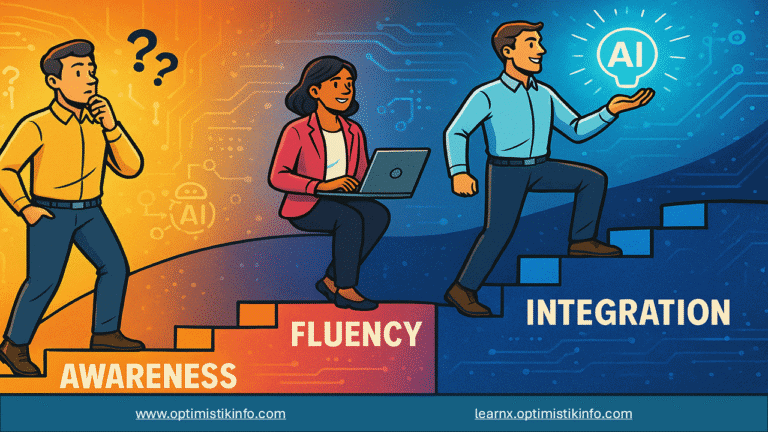
And this is where OPTIMISTIK INFOSYSTEMS helps individuals and teams stay confident, relevant and future-ready through practical, domain-aligned AI learning pathways.
Ready to Get Your Team Future-Ready?
If you or your organisation want to stay ahead of the curve — not chase it — we’re here to help.
Let’s explore how AI-focused learning can strengthen your workforce for the decade ahead.
DM us or write to info@optimistikinfo.com or reach out through our website to start the conversation.